
Part I
The Great Regulatory Request
In September 2025, Colombia made a significant regulatory decision with Resolution 1888 of 2025. Responding to the global push for interoperability and the risk of falling behind other countries technologically, the government issued a direct mandate to hospitals, healthcare providers, and healthcare institutions: implement a Digital Attention Summary (RDA) in HL7 FHIR R4 format and submit it to the National Interoperability Platform.
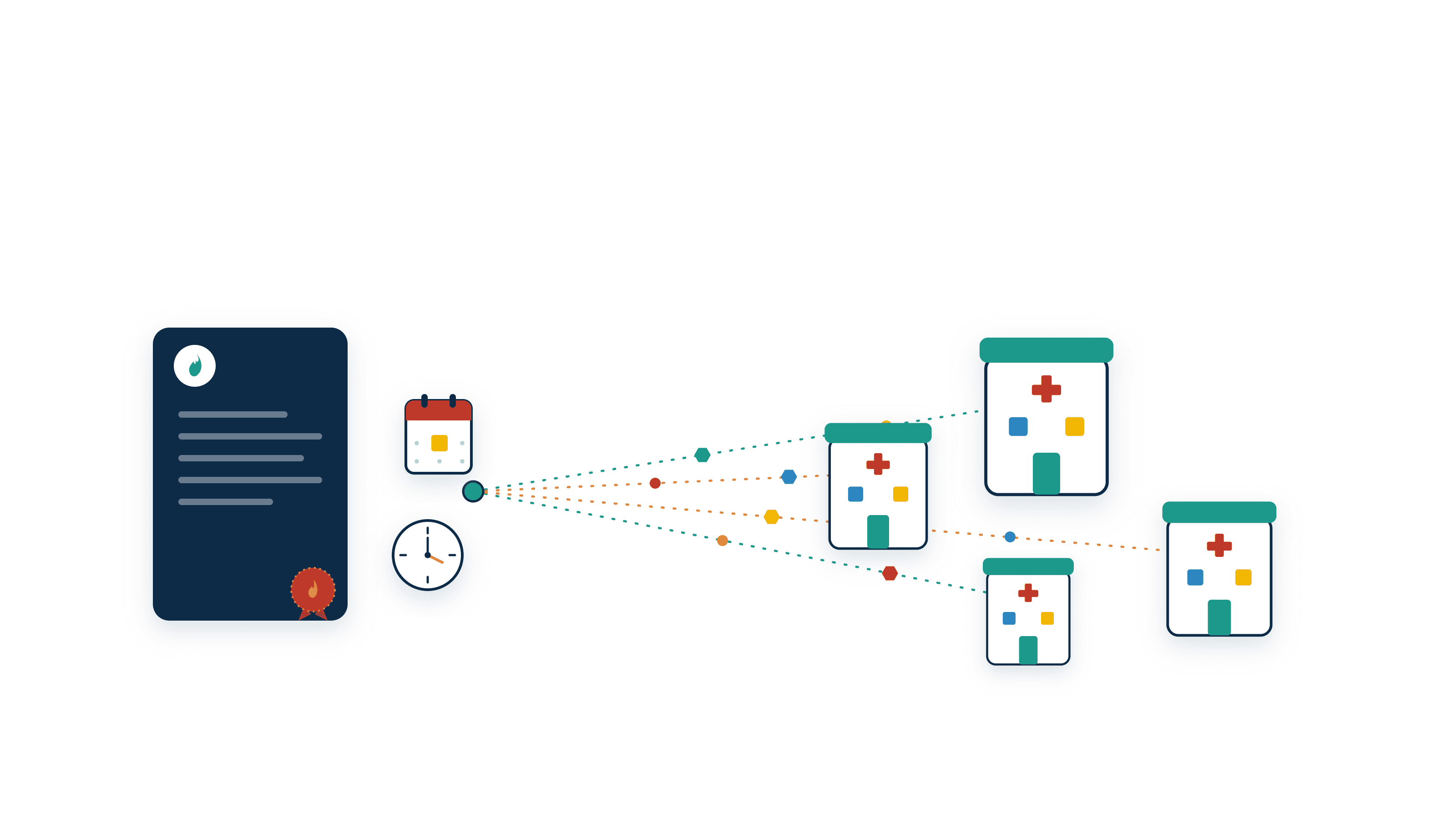
A single mandate, dated and addressed to every provider: Resolution 1888 routes the RDA from the State to every obligated IPS at once.
Before continuing, it is important to clarify the primary aim of this report: to provide a complete, 360-degree analysis of how this law and related initiatives could directly or indirectly affect the IVD and medical device sectors in Colombia. Its key differentiator is that the analysis draws on a comparison with the Australian framework and the implementation path followed by institutions that contributed to a similar transformation more than 12 years ago.
1. What does interoperability mean?
Technology has advanced rapidly over the past decade. Many existing systems have evolved quickly, while new ones have emerged, and these changes are now reshaping the healthcare sector. Hospitals, laboratories, and healthcare providers are increasingly approached by companies offering equipment upgrades and new devices. The challenge is that each medical device must connect either to healthcare software or to other medical devices. Even a single connection or API requires careful development by software engineers and domain experts to ensure medical data is accurate, secure, and reliable. Now imagine institutions having to repeat this process for every device, as well as for government platforms or cloud systems. This becomes a mathematical problem: development costs grow exponentially with each additional connection in the network.
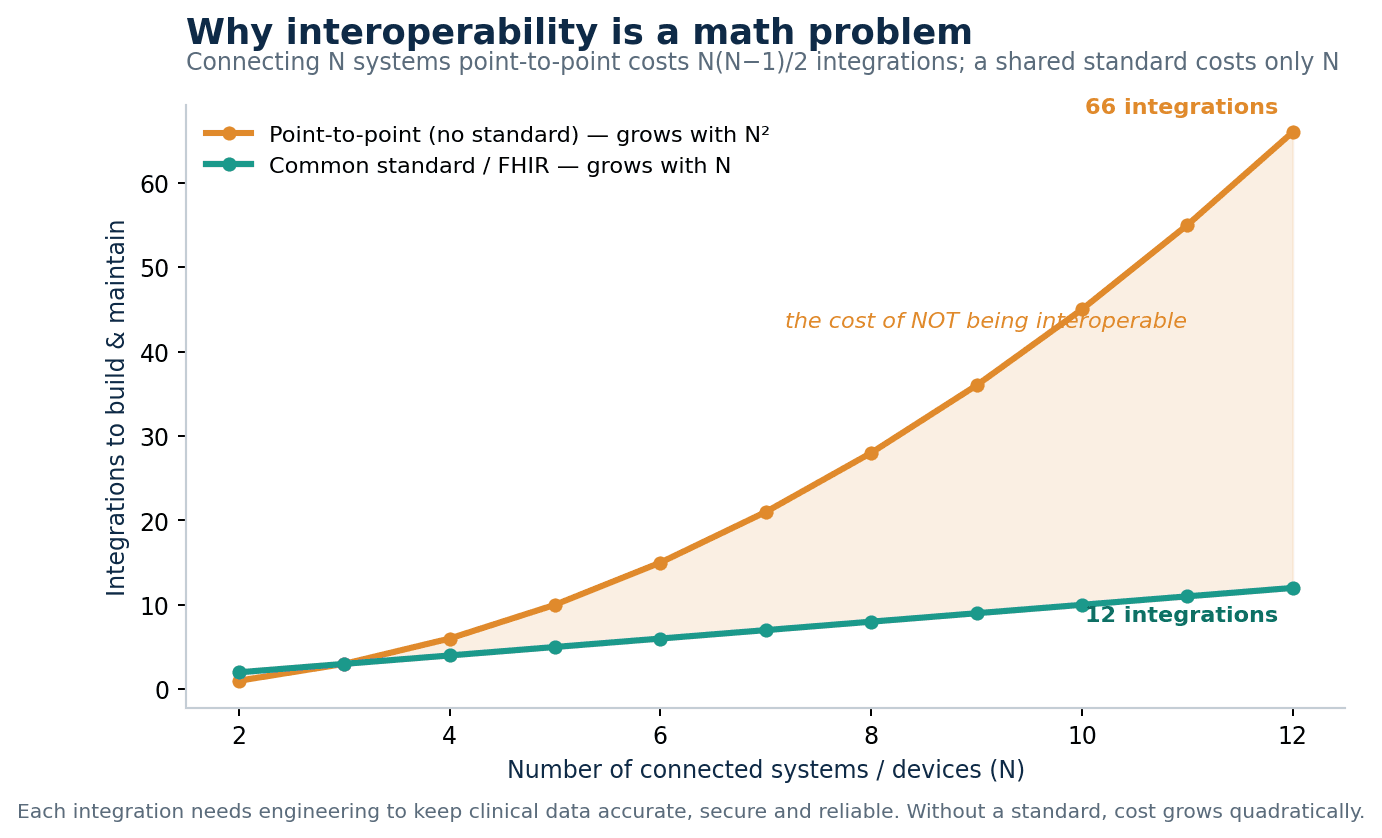
This is what “interoperability” really means: not that two machines exchange a file once, but that every system in the network can understand every other through one shared language — so the curve bends from the steep one to the flat one. Interoperability is, before anything else, a way to stop paying the quadratic cost of isolation.
2. How does HL7 approach the problem?
The answer to this math problem is not better cables; it is a common language. That is the role of HL7, the international body that has defined the standards for clinical data exchange for three decades. Its first widely adopted standard, HL7 v2, worked — but it was a language of point-to-point messages, where each pair of systems still had to negotiate the details. It produced exactly the explosion of connections described above.
Its modern answer is FHIR (Fast Healthcare Interoperability Resources). FHIR borrows the architecture of the modern web: it breaks clinical information into standard, reusable building blocks — called Resources — that any system can read through the same kind of interface (an API) that powers the apps on a phone. A patient, an observation, a laboratory report: each is a Resource with a known shape. Instead of every device speaking its own dialect, all of them speak FHIR, and the cost of connection collapses from N² to N. This is the idea Colombia chose to adopt — and the foundation on which Resolution 1888 is built.
3. Resolution 1888 of 2025 and its relationship with interoperability
Resolution 1888 of 2025 is Colombia's decision to make that common language mandatory. From 15 April 2026, every healthcare provider (IPS) must generate a Digital Attention Summary (RDA) in HL7 FHIR R4 and submit it to the Ministry's national interoperability platform (the IHCE). It is law, not a recommendation.
The norm defines four kinds of RDA, and all four are built around a clinical encounter: a patient summary (after any event), an outpatient-visit summary, an emergency summary, and a hospitalization summary (at discharge). Each is a FHIR Bundle — a Composition resource wrapped around the relevant clinical data — transmitted to the centralized platform. The transition period is six months; and here is the first honest nuance: the 15-April-2026 date is arithmetic, derived by adding six months to the 15 October 2025 start — not a date written literally in the text.
But the headline hides three nuances that change completely who the norm hits, and when — and those nuances are the difference between a report that sells fear and one that sells positioning.
4. The legal framework: a pyramid of interconnected norms
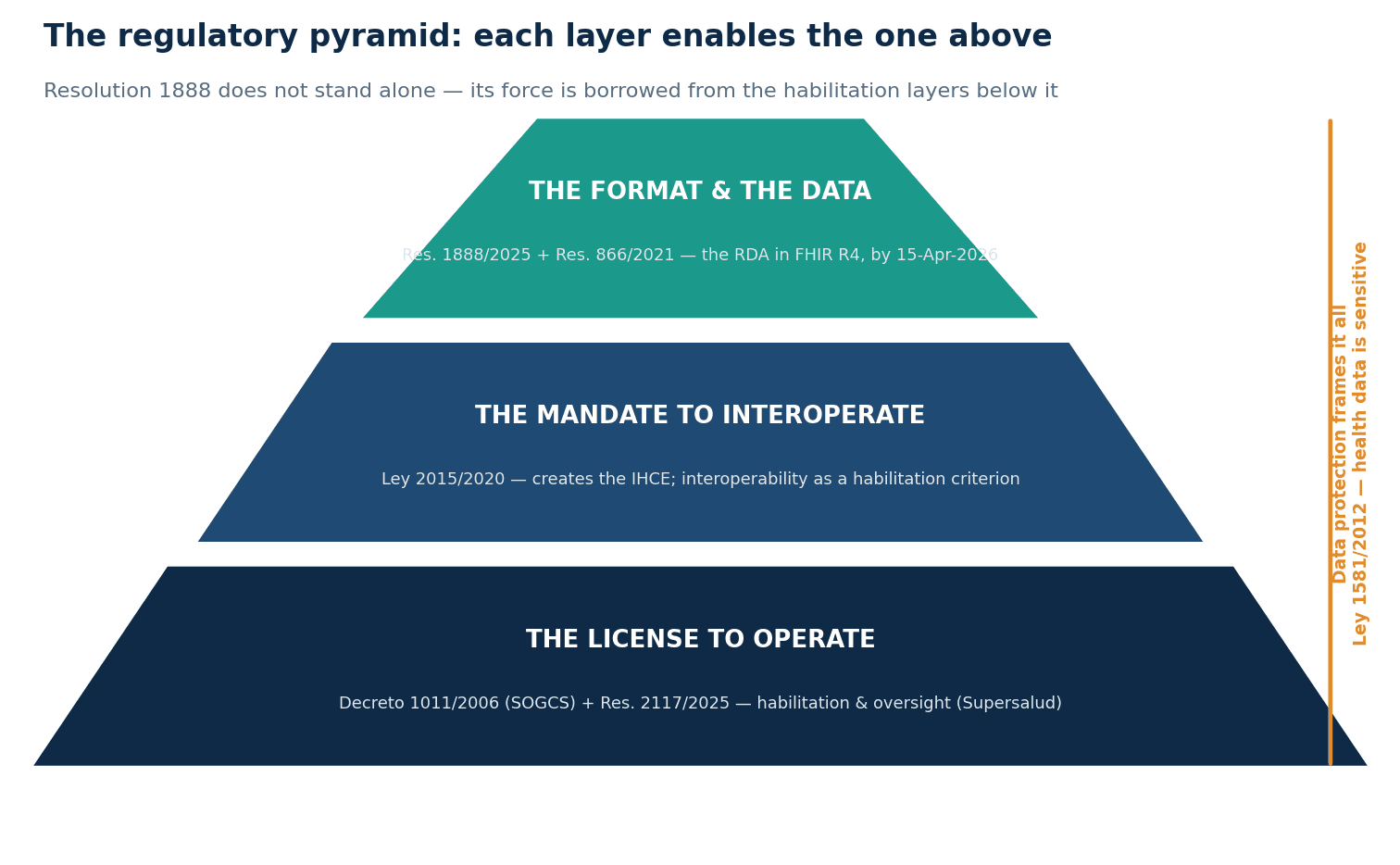
Resolution 1888 does not stand alone. It rests on a pyramid of six norms, and its real force comes not from itself but from how it clips onto the ones beneath it. The norms should not be read in isolation.
At the base sits the license to operate: Decreto 1011 of 2006 (the quality-assurance system, SOGCS) and Resolution 2117 of 2025, enforced by the Superintendencia Nacional de Salud. Above it, Ley 2015 of 2020 creates the IHCE and — critically — lets the Ministry make interoperability a condition of habilitation. At the top sit the format and the data: Resolutions 866 and 1888, which define what is exchanged and in what shape. Framing all of it, Ley 1581 of 2012 protects health data as sensitive, with fines that reach 2,000 monthly minimum wages.
The key analysis
5. How does interoperability resonate in the IVD sector?
So where does an IVD or medical-device company sit in all this? Not, as one might first assume, on the list of the obligated — and not, as an earlier reading of this market suggested, at immediate risk of losing public bids. The honest picture is more subtle, and more strategic.
The IVD analyzer does not speak FHIR. It speaks HL7 v2 and ASTM — the older dialects — and it sends its results to the laboratory's information system, the LIMS. Today the structured laboratory result is deferred from the RDA, so no rule yet forces that analyzer's data onto the national platform. But two things are already true, and one is coming: the IPS is obligated now; the data the analyzer produces must eventually reach the HIS that builds the RDA; and when laboratory results enter the RDA in a later phase — or when new LIMS policies follow — the chain from analyzer to LIMS to HIS to RDA will need a middleware translation layer that turns HL7 v2/ASTM into FHIR.
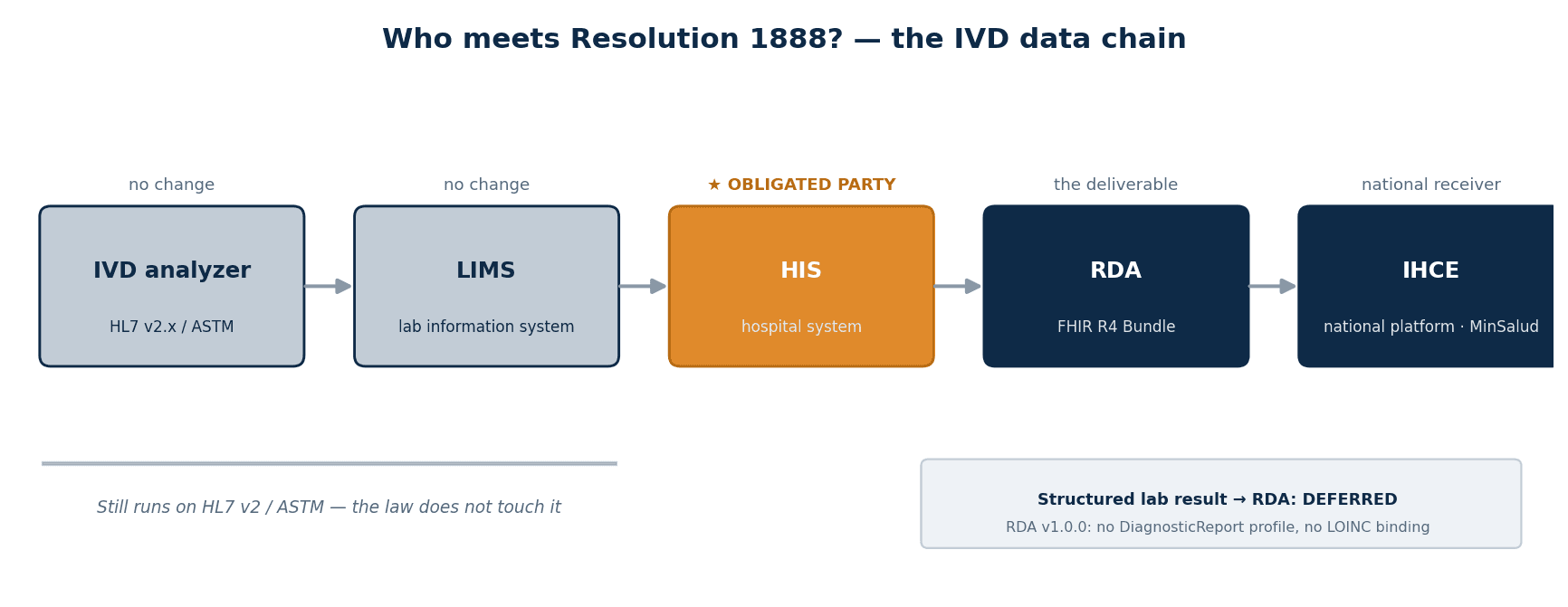
The implication for the sector is therefore not panic, but awareness: IVD and device companies need to understand the new regulatory system now, because the policies that will govern how their data flows are being written — and the equipment they sell was not born speaking the language the State will require.
6. Who is obligated — and who is not?
The obligated parties are the providers and related actors named in Article 2 of Resolution 866 — the IPS. The IVD distributor and the laboratory are not directly obligated; nor is the LIMS. The technical point where the norm is met is the HIS, which aggregates the data — including what arrives from the laboratory — and produces the RDA Bundle.
An operational detail confirms it: the Hércules platform issues the technical credentials (ClientID/ClientSecret) only to habilitated providers, not to software vendors. The integrator integrates, but it is the IPS that accredits before the State. The distributor, at most, enables — it never answers.
7. Cross-analysis: the Australian mirror (preview)
It helps to see the same destination reached by someone who arrived earlier. Australia built the same thing — a national clinical summary in FHIR — but over fourteen years and in the opposite order: identity first (the Healthcare Identifiers Act of 2010), a network of secure-messaging “translators” since the 1990s, and FHIR mounted on top at the end (the National Healthcare Interoperability Plan 2023–2028 and the Modernising My Health Record / Sharing-by-Default Act of 2025). Colombia inverted that sequence: it adopted the standard while its national identity layer (VIDA/MPI) is still under construction and without an equivalent messaging network.
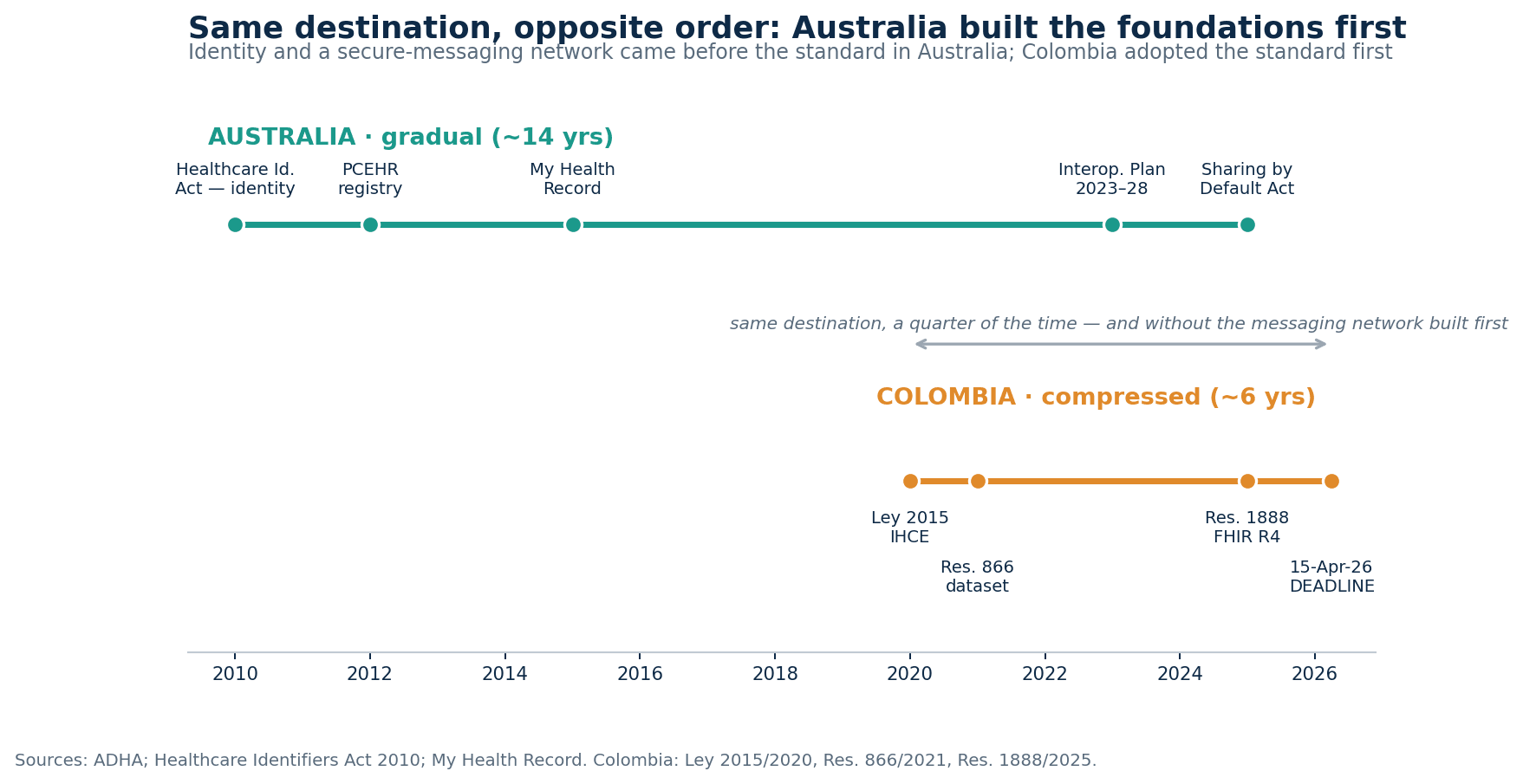
That contrast — what Colombia can learn from the institutions that ran this race a decade ago — is rich enough to deserve its own study. We treat it here only as a preview; the full cross-analysis, institution by institution, is the subject of our forthcoming second report.
8. The strategic implication
Three consequences follow, and they carry the rest of this report. First, the compliance pressure is real but indirect — it bites through habilitation, not through a fine. Second, compressing the calendar without the infrastructure leaves a gap — the “last mile” of the data, from equipment to RDA, that someone must fill. Third, and most important for the opportunity: the structured laboratory result is deferred, but it is dated on the horizon. When it enters the RDA, the LIMS↔FHIR and CUPS↔LOINC mapping will become mandatory — and today no one has solved it. That is the ground where the first mover wins.
9. Honest caveats and pending verification
A sound analysis names its own limits: (1) the 15-April date is arithmetic, not literal; (2) Resolution 1888 has no penalty of its own — it is enforced through habilitation and the Superintendencia; (3) the structured laboratory feed is deferred; (4) these points come from the norm and the RDA Implementation Guide and should be confirmed against the current official guide (vulcano.ihcecol.gov.co) before publication.
A word from the author

Part II
The Chain and the Bottleneck
Part I settled the mandate — the what and the when. Part II follows a single number on its journey: a glucose value, a viral load, a positive culture. We trace it from the moment the analyzer prints it to the moment it lands inside the RDA the State now demands. Somewhere along that path the data has to change languages, and the exact joint where that translation happens — or fails to — is where interoperability stops being a law and becomes plumbing.
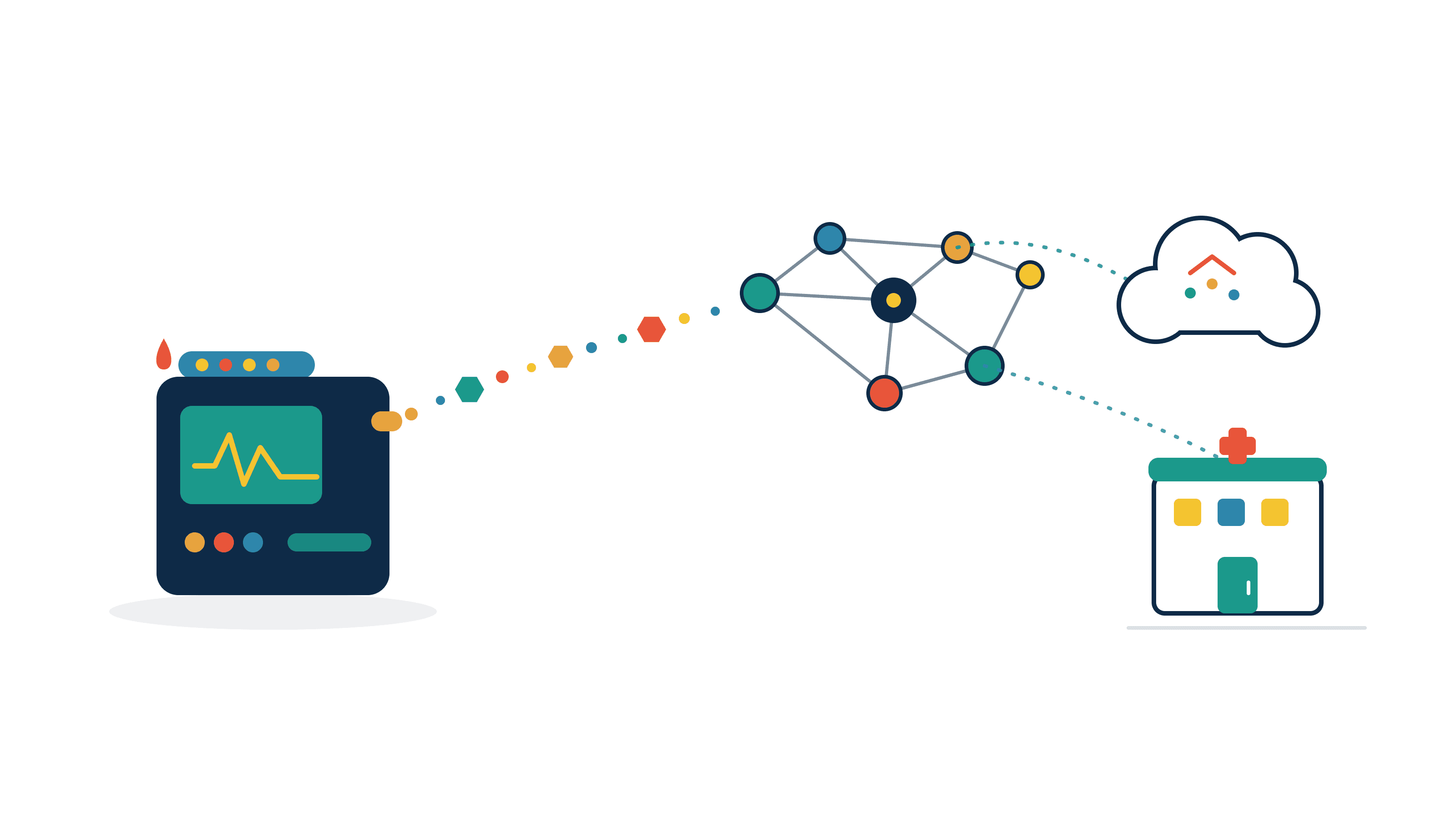
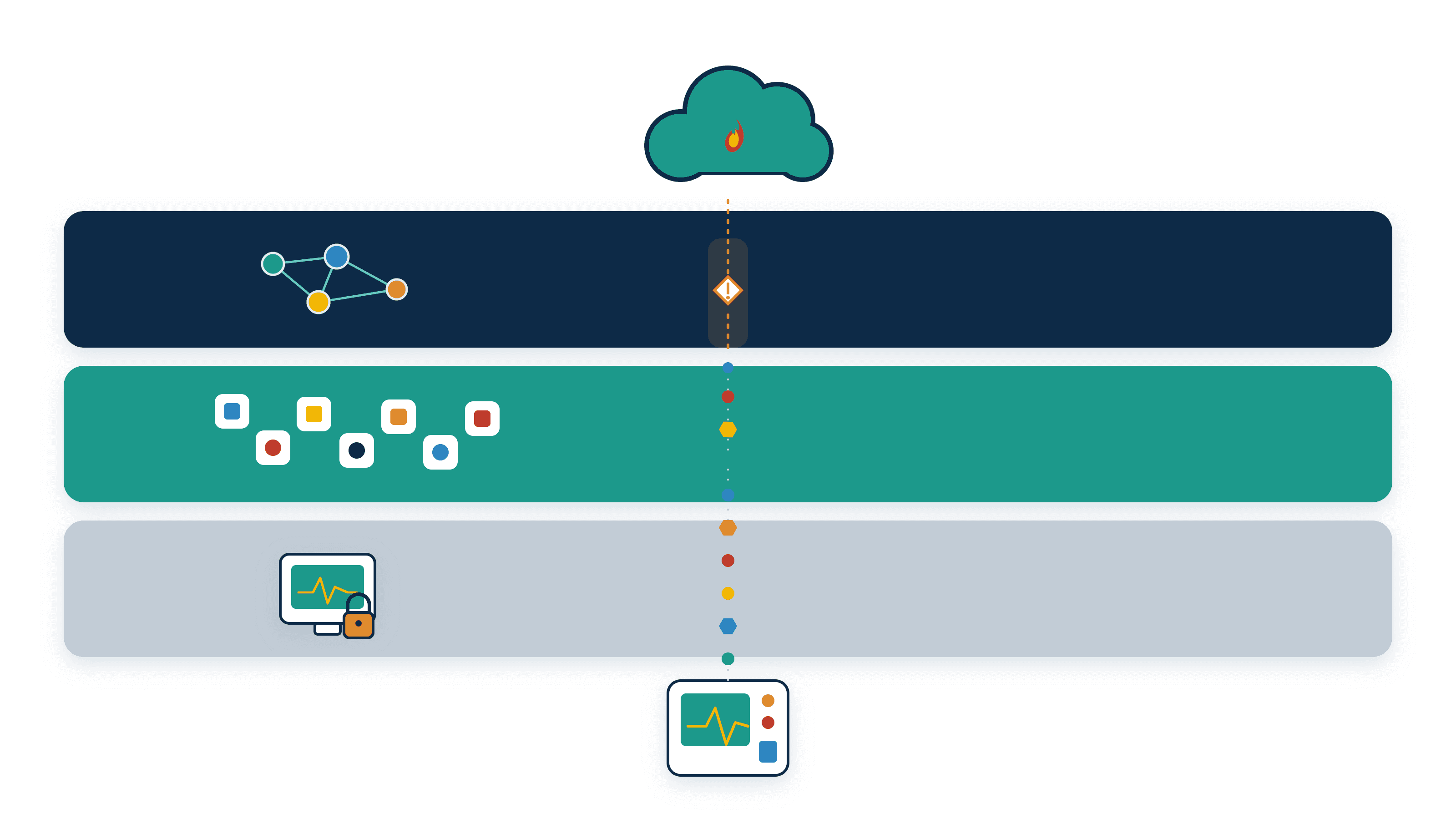
From the analyzer, through the knowledge graph, to the FHIR cloud and the clinic — the full path a result must travel.
1. How a result travels: from the analyzer to the RDA
Picture the path of one lab result. It begins inside an IVD analyzer — a chemistry instrument, an immunoassay platform, a molecular panel. The analyzer emits its result in the dialects it was born speaking: HL7 v2.x and ASTM, usually over the IHE LAW (Laboratory Analytical Workflow) profile, which is itself built on HL7 v2. It does not speak FHIR, and it was never designed to.
From there the result flows to the LIMS — the laboratory information system that receives, validates and stores it. The LIMS is the lab's system of record, and internally it too lives in the v2/ASTM world. It then passes the validated result upward to the HIS, the hospital information system that holds the patient's encounter. And it is the HIS — not the analyzer, not the LIMS — that assembles the RDA: the FHIR R4 Bundle the IHCE expects.
The shape of the chain matters more than any single box in it. FHIR appears only at the very top. Everything below — the instrument, the lab system, most of the internal traffic — speaks the older dialects, and will keep speaking them for years. So the right question is not the intuitive one. It is not “does every machine speak FHIR?” They do not, and they do not need to. The real question is narrower and sharper: is there a single point in the chain where v2/ASTM gets translated into FHIR R4? That point is the whole game.
2. Where the chain breaks: the translation gap
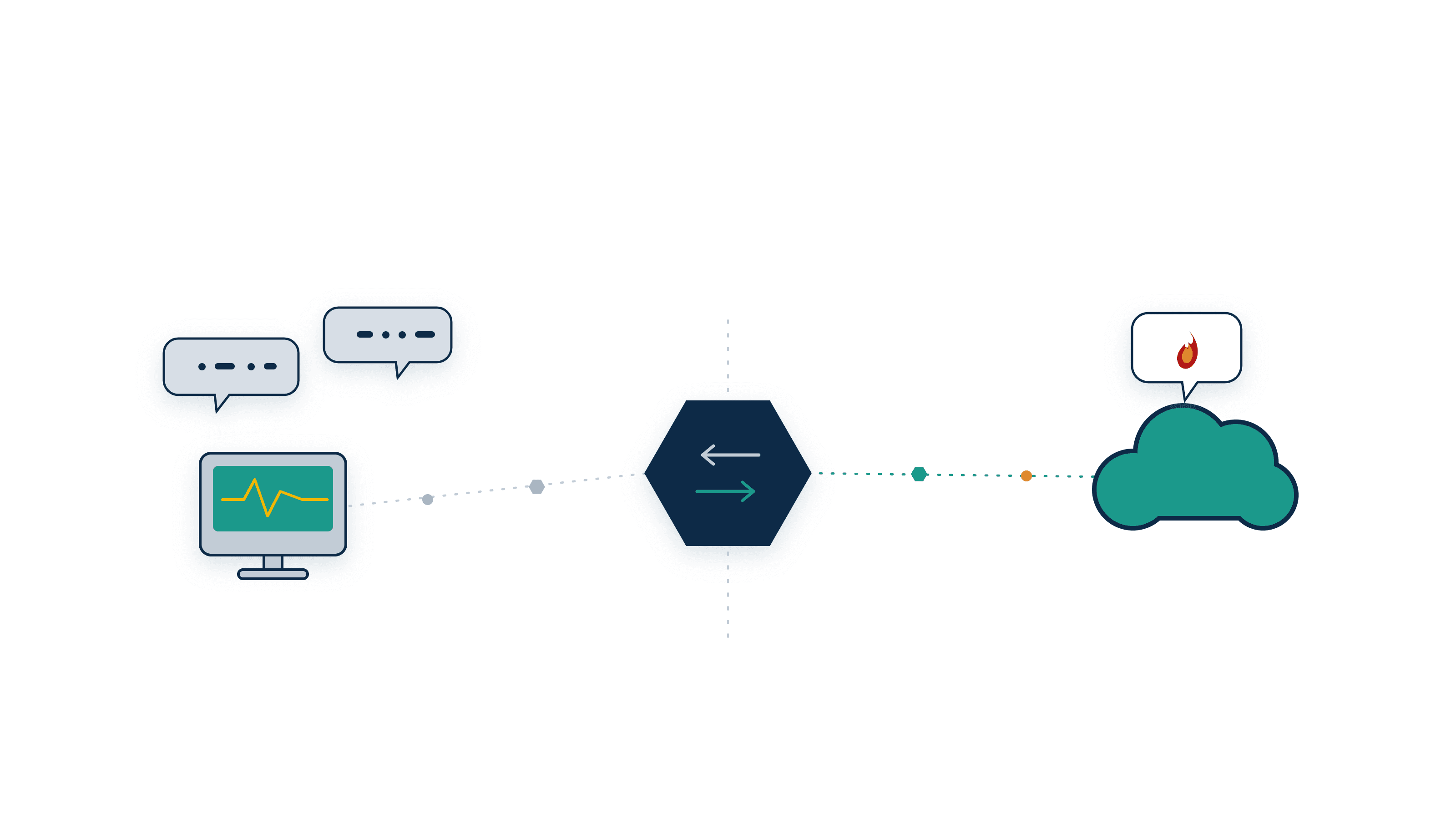
If FHIR lives only at the top and the instruments live only at the bottom, then somewhere in between a translation must occur. That translating layer has a name in health IT: middleware — an integration engine that converts and routes between formats. When it is present, the result climbs the chain, changes languages once, and arrives as a clean FHIR resource. When it is absent, the result reaches the top still speaking v2, and the RDA for that data cannot be assembled. The gap is not a missing cable. It is a missing interpreter.
The analogy worth keeping
3. The honest correction: where the compliance point actually sits
Here the easy version of the story overreaches, and a serious analysis has to say so. The tempting claim is: “if the analyzer does not speak FHIR, the IPS cannot comply.” Stated that strongly, it is wrong today — and two nuances, both drawn straight from the RDA guide, correct it.
First, the detailed laboratory result is deferred. The RDA v1.0.0 does not model a lab result with a DiagnosticReport profile bound to LOINC. It models it as ProcedureResultRDA — a single Observation coded in CUPS, the Colombian procedure nomenclature, not in LOINC. The structured, analyzer-level feed of discrete results is contemplated for a later phase. So the near-term pressure of April 2026 falls on the encounter RDAs — outpatient, emergency, inpatient — not on a structured feed coming off the IVD instrument.
Second, the point of compliance is the HIS, not the analyzer. The HIS aggregates everything that reaches it — including lab results that arrive the old way, over HL7 v2 — and it is the HIS that builds the RDA Bundle. An IPS can comply at the HIS level even while the internal stretch from analyzer to LIS to HIS stays entirely in v2. The instrument does not have to learn FHIR for the hospital to meet the mandate this year.
Why this matters — and why it still favors the IVD lane
4. The coupling nobody draws: shared reference laboratories
There is a structural feature of the Colombian chain that a box-and-arrow diagram hides. Most IPS do not run a full laboratory. They draw the sample and send it to a shared reference laboratory that serves dozens — sometimes hundreds — of providers at once. That arrangement is efficient, but it creates coupling: the translation capability of one reference lab is silently inherited by every IPS that depends on it. Build the FHIR bridge there, and many providers comply at once; leave it unbuilt, and the same gap propagates across all of them simultaneously.
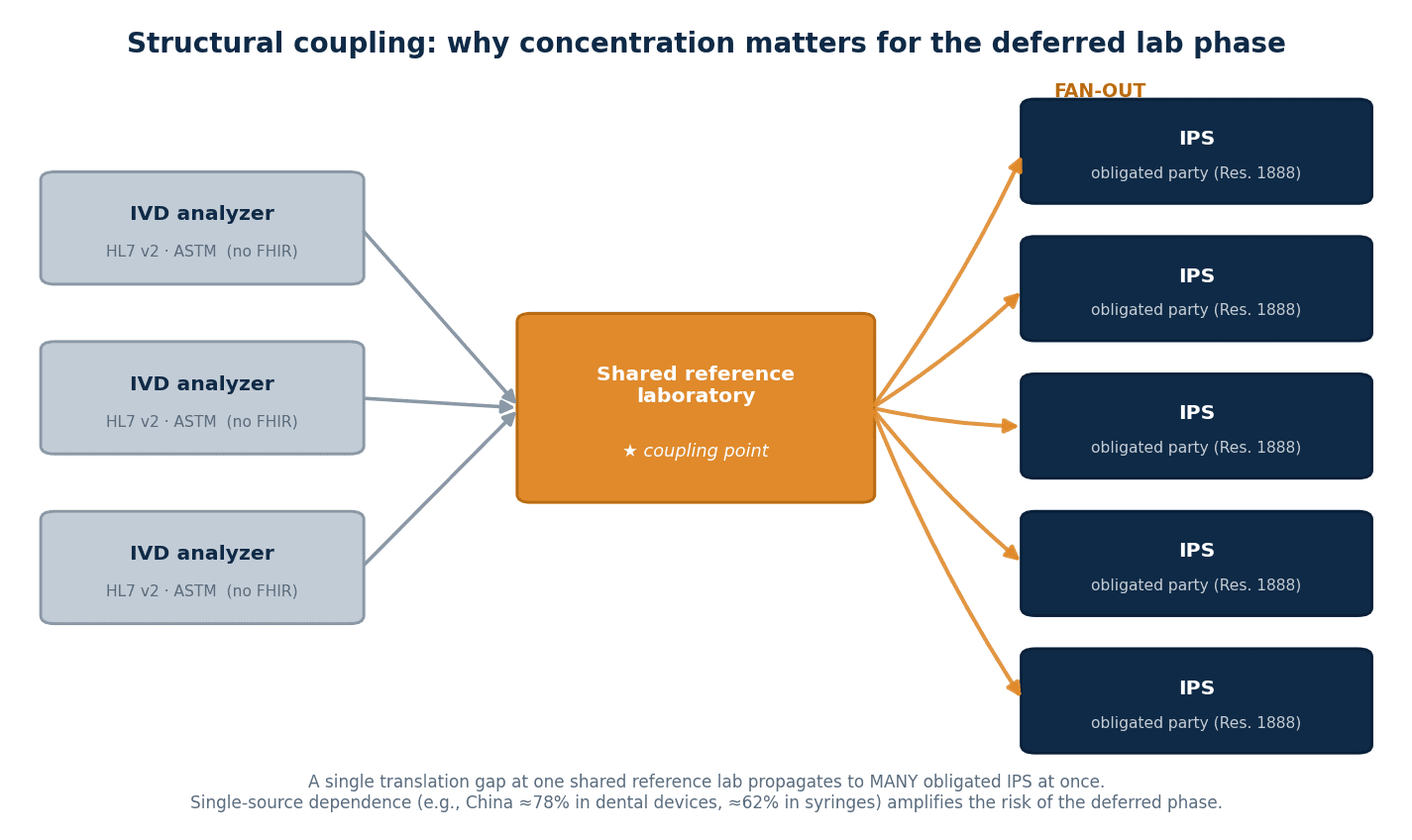
This is the first place in the study where network thinking earns its keep. Compliance is not a property each hospital holds alone; it is a property of a graph with hubs. A handful of reference laboratories sit at high centrality, and the system's readiness depends disproportionately on them. That same lens — supply structure as a network with concentrated, load-bearing nodes — is the engine of Report 2, where we turn it on the import market itself.
5. Does Colombia have the translator? The national backbone
Before judging the gap, give the State its due: the foundation is genuinely built. The IHCE backbone is real and substantial. It runs on Azure Health Data Services and bundles the pieces a national exchange needs — a FHIR server as repository and API, the MPI / VIDA national patient identity, a terminology server carrying SNOMED CT, LOINC, CIE and CUPS, an RDA Manager and Viewer, and an API Gateway for authentication and audit. The IHCE projects on the order of 400 million FHIR documents a year across 9,000-plus provider organizations. This is not a sketch; it is a platform.
But notice exactly where the platform stops. The IHCE expects each provider to operate its own ETL layer — extracting from its HIS, RIS, LIS and pharmacy systems and mapping them into the Colombian FHIR profiles. That ETL is the middleware. The State built the highway and the destination; every provider still has to build its own on-ramp. The national backbone does not close the gap of Section 2 — it relocates it, cleanly, to the edge of each institution.
6. Who builds the on-ramp: the three vendor layers
The on-ramp is not unoccupied. Three distinct layers of vendors are already working the translation problem, and they are easy to confuse until you separate them by what they actually mediate.
| Layer | What it is | Who is here | The catch |
|---|---|---|---|
| Manufacturer | Proprietary hub tied to one brand's instruments | Roche navify Pathology Lab Hub | Brand lock-in; not vendor-neutral RDA compliance |
| HIS | Generates the RDA from its own system, point-to-point | Saludtools · Medifolios · DigitalWare (Hosvital) · SYAC · Servinte/Osigu | Solves the clinical summary from its own data — not third-party devices or labs |
| Integration engine | Translates HL7 v2/ASTM → FHIR, vendor-neutral | Mirth Connect (NextGen) · InterSystems IRIS/HealthShare · K2BHealth · IBM ACE (via Assist) | The true translation layer — but thin, and unevenly deployed |
Read the table top to bottom and the pattern is clear. The HIS layer is crowded — nearly every local vendor now advertises an RDA module — but each one generates the summary from its own system; none is a neutral engine that mediates a third party's analyzers and labs into FHIR. The manufacturer layer (Roche navify and its peers) solves connectivity beautifully, but only for its own boxes, and on lock-in terms. The engine layer is the one that truly translates — Mirth Connect supports lab analyzers natively and is the most plausible workhorse for a device-to-FHIR bridge; InterSystems brought its “FHIR façade” pattern and a Colombia office; K2BHealth built Uruguay's national EHR and is openly marketing Resolution 1888. But this layer is thin and unevenly deployed, and the device-to-FHIR “last mile” is its thinnest stretch.
7. The gap Australia did not have: secure messaging
To see why that last mile is so thin, compare the two countries at the layer nobody photographs. Australia spent two decades building an intermediate layer that Colombia simply skipped: a mature secure clinical-messaging / HIE network — HealthLink (operating since 1993), Medical-Objects, Argus — carrying clinical traffic between more than 15,000 organizations and over 100 million messages a year. It replaced the fax for results, referrals and discharge summaries, and in doing so it already translated and routed between systems long before FHIR arrived.
Colombia jumped straight to a centralized FHIR hub without that middle layer ever existing at national scale. Historically, clinical exchange here moved on paper, fax, or CSV and Excel files. The consequence is structural, and it is the real content behind the maturity gap noted in Part I: the last mile from devices and labs into FHIR is, to a large degree, still unbuilt. Australia poured FHIR onto a network of interpreters that already worked. Colombia wrote the law first and is now discovering it must build the interpreters underneath it.
8. The honest verdict: real, but closing
So is the gap an open field? No — and saying so would discredit the whole analysis, because anyone who knows the market would name the two players already standing on it. Assist (Bogotá) does precisely the engine angle, using IBM ACE v13 to move HL7 v2 to FHIR bidirectionally across HIS, RIS, LIS, pharmacy and laboratory with the national catalogs — a strong fit for large hospitals on an enterprise-consulting model. Clau (a LATAM SaaS platform) translates HL7 to FHIR and normalizes to SNOMED automatically across Colombia, Mexico and Chile, and attacks on price — roughly USD 500–2,500 a month against the USD 50,000–200,000 setups of the traditional model.
The verdict, stated plainly
That is the bridge out of Report 1. Part I gave the mandate; Part II followed the data through the pipe and located the true bottleneck — not the analyzer that everyone fears, but the unfinished last mile and the deferred lab profile that almost nobody is watching. Report 2 now turns from the pipe to what flows through it: who actually supplies Colombia's diagnostic equipment, how that supply network is shaped, where it concentrates, and where — read as a graph rather than a list — its fragilities and its openings really lie.
Appendix
References & the series
Colombia — regulation & standards
Resolution 1888 of 2025 — RDA in HL7 FHIR R4 (D.O. 53.244)
Resolution 866 of 2021 — minimum clinical dataset
Ley 2015 of 2020 — IHCE; interoperability as a habilitation criterion
Ley 1581 of 2012 — protection of sensitive health data
Decreto 1011 of 2006 (SOGCS) + Resolution 2117 of 2025
RDA Implementation Guide v1.0.0 — HL7 Colombia / IHCE
Australia — framework
Healthcare Identifiers Act 2010 (IHI / HPI)
My Health Records Act 2012; Sharing-by-Default Act 2025
Privacy Act 1988 + Australian Privacy Principles
ADHA — National Healthcare Interoperability Plan 2023–2028; AU Core IG
Secure messaging — HealthLink, Medical-Objects, Argus
Standards & terminologies
HL7 FHIR R4 (4.0.1); IHE LAW (Laboratory Analytical Workflow)
SNOMED CT, LOINC, CIE, CUPS
Market & ecosystem (public materials, 2025–2026)
HIS — Saludtools, Medifolios, DigitalWare, SYAC, Servinte/Osigu
Engines — Mirth Connect (NextGen), InterSystems, K2BHealth, IBM ACE (via Assist), Clau; Roche navify
All dates, figures and vendor claims should be verified against primary sources before use in tenders or publication. This is a study document, not legal advice.
The series — upcoming volumes
Vol. 02
The Colombian IVD & medical-device market
Market size and composition, the supply network read as a graph, single-source fragilities, and the China / Mindray entry point — the commercial map behind the mandate.
Vol. 03
Colombia ↔ Australia: the cross-analysis
A maturity matrix and a 14-year timeline — what Colombia can learn from the institutions that ran this race a decade ago.

Andrey Torres
Biomedical engineer · HL7 FHIR R4 clinical interoperability · andreytorres.com